Tuesday, February 07, 2006

Friday, February 03, 2006
3 things
1. Harper Lee, racist
Sometimes I read things and I just like to assume it's a joke. In this case, I'm hoping it's a joke on the part of the person who sent the letter. Really, really hoping.
Assuming it's not a joke, this is an interesting way to consider the topic of literacy. Is being literate simply the ability to read and write? Or does it involve actually being about to understand more than the most basic and literal meanings of words? I'm not saying you have to be able to understand Gravity's Rainbow, I'm just thinking that literacy isn't entirely useful if you think 1984 is just a sci-fi story or think that To Kill a Mockingbird is racist.
2. And speaking of 1984 ...
Note to high school writers: Don't read Chuck Palahniuk, Bret Easton Ellis, or even Stephen King. Or, if you must, please make sure they have no influence on anything you ever want to turn in for class. Unless you want to end up like this, apparently.
Why this story really strikes me beyond all that silly civil liberties nonsense ...
When I was a freshman in high school I wrote a novel, the first of several I wrote during those years. (I haven't finished a single one since.) It was bad in a lot of ways and I'd really rather not go into the plot, but one of the key scenes in the book was when, during the homecoming dance in my school cafeteria, a deranged student blew up the building, killing nearly everyone inside.
At the time, it didn't much occur to me that I could get myself in a lot of trouble if the wrong people found the book. Actually, a lot of people around the school read it and at least one copy was passed from student-to-student quite indiscriminantly. I knew I didn't want a teacher to read it, but I don't suppose I expected to get in much trouble if one ever did. But five years later, two deranged kids walked into their high school and started shooting. They also had every intention of setting off bombs that would have killed or seriously injured hundreds of people in the cafeteria. When I heard about Columbine my first thought was of friends of mine who were students there and if they were OK; my second thought was about that old story I'd written.
Maybe part of my lack of worry about the story at the time was that the whole thing was treated as a distaster. The person responsible was very clearly a villain in every way. The descriptions of what happened were of acts of heroism by survivors and tender scenes recounting those who died. Anyway, that was my intention, I don't know that I was a good enough writer to fully convey the emotion. But nonetheless, it wasn't cruel or vindictive or scary. It was a scene of tragedy.
Still, if someone had found it and I had been expelled it wouldn't be hard for the media to have simply portrayed me as the kid who wrote a book about blowing up his school. Hell, I'd even tried to figure out what supports you;d have to crumble to bring the roof down and what kinds of explosives might do the trick.
To me, the story the kid in Minnesota wrote sounds like something that was aiming at comedy. But the one about shooting the teacher does sound threatening and I'm certainly not going to blame the teacher for reporting that she felt threatened. But how did we skip all the steps where the kid and his parents were contacted by (a) the school or (b) law enforcement to talk about the problem? Then again, in this day and age, maybe the kid's lucky he got out at all.
3. Oh, and this is awesome.
I sometimes think that, if Murray is pretty much Garfield, then Mason is a lot like Bucky. (In which case Murray is also rather like Satchel, sadly).
Sometimes I read things and I just like to assume it's a joke. In this case, I'm hoping it's a joke on the part of the person who sent the letter. Really, really hoping.
Assuming it's not a joke, this is an interesting way to consider the topic of literacy. Is being literate simply the ability to read and write? Or does it involve actually being about to understand more than the most basic and literal meanings of words? I'm not saying you have to be able to understand Gravity's Rainbow, I'm just thinking that literacy isn't entirely useful if you think 1984 is just a sci-fi story or think that To Kill a Mockingbird is racist.
2. And speaking of 1984 ...
Note to high school writers: Don't read Chuck Palahniuk, Bret Easton Ellis, or even Stephen King. Or, if you must, please make sure they have no influence on anything you ever want to turn in for class. Unless you want to end up like this, apparently.
Why this story really strikes me beyond all that silly civil liberties nonsense ...
When I was a freshman in high school I wrote a novel, the first of several I wrote during those years. (I haven't finished a single one since.) It was bad in a lot of ways and I'd really rather not go into the plot, but one of the key scenes in the book was when, during the homecoming dance in my school cafeteria, a deranged student blew up the building, killing nearly everyone inside.
At the time, it didn't much occur to me that I could get myself in a lot of trouble if the wrong people found the book. Actually, a lot of people around the school read it and at least one copy was passed from student-to-student quite indiscriminantly. I knew I didn't want a teacher to read it, but I don't suppose I expected to get in much trouble if one ever did. But five years later, two deranged kids walked into their high school and started shooting. They also had every intention of setting off bombs that would have killed or seriously injured hundreds of people in the cafeteria. When I heard about Columbine my first thought was of friends of mine who were students there and if they were OK; my second thought was about that old story I'd written.
Maybe part of my lack of worry about the story at the time was that the whole thing was treated as a distaster. The person responsible was very clearly a villain in every way. The descriptions of what happened were of acts of heroism by survivors and tender scenes recounting those who died. Anyway, that was my intention, I don't know that I was a good enough writer to fully convey the emotion. But nonetheless, it wasn't cruel or vindictive or scary. It was a scene of tragedy.
Still, if someone had found it and I had been expelled it wouldn't be hard for the media to have simply portrayed me as the kid who wrote a book about blowing up his school. Hell, I'd even tried to figure out what supports you;d have to crumble to bring the roof down and what kinds of explosives might do the trick.
To me, the story the kid in Minnesota wrote sounds like something that was aiming at comedy. But the one about shooting the teacher does sound threatening and I'm certainly not going to blame the teacher for reporting that she felt threatened. But how did we skip all the steps where the kid and his parents were contacted by (a) the school or (b) law enforcement to talk about the problem? Then again, in this day and age, maybe the kid's lucky he got out at all.
3. Oh, and this is awesome.
I sometimes think that, if Murray is pretty much Garfield, then Mason is a lot like Bucky. (In which case Murray is also rather like Satchel, sadly).
Linguistics In The Bedroom
Hi there! It's Friday! I love Fridays, don't you? To celebrate, let’s talk for a moment about orgasms! (No, I’m only kidding.) Let’s talk about the way we talk about orgasms! (That time I was serious.)
I’m interested in language anyway and being in a linguistics class right now has really heightened that, plus this topic has always been one of particular interest to me. English, being both the world’s current language of record and eternally broad and flexible, has been studied almost to the point of exhaustion linguistically. But no one spends too much time talking about dirty words, really, and that’s a shame – in some ways they’re the most fun of all. 1
I’m interested in language anyway and being in a linguistics class right now has really heightened that, plus this topic has always been one of particular interest to me. English, being both the world’s current language of record and eternally broad and flexible, has been studied almost to the point of exhaustion linguistically. But no one spends too much time talking about dirty words, really, and that’s a shame – in some ways they’re the most fun of all. 1
Perhaps they’re unique precisely because they’re so rarely discussed in proper company, because no one quite wants to sit down and say, This is the proper way to use motherfucker and please for the love of all things holy stop spelling it mothafucka.They might have revised Strunk & White with pictures, but they’re never going to revise enough to help anyone who knows the word cunt but doesn’t know it’s not a good idea to use the word in mixed company.
But back to orgasms. I would say this only occurs to me because I’m a writer – what I mean to discuss here is a spelling convention, it’s nothing to do with the way you talk – but then again I’ve never written any kind of erotica or porn that includes an especially explicit reference to an orgasm. I’ve written some sex scenes, but mostly they’re just preludes or general reactions – only in very extreme circumstances can I imagine a serious work of fiction needing to describe the angle and force of each thrust. And if I ever have the need, I think I tend to refer to being “finishing” or “when it was over,” and not the act of orgasm itself. I may have written the “c” word in the previous paragraph, but there’s always a small part of me that’s just a tiny bit prudish.
So maybe it’s something I’ve noticed as a reader. Or maybe it’s a non-issue that only I’m interested in. (Shocking, I know, but it’s happened before.)
My question is: Do people come or do they cum? I’m pretty much exclusively talking about it in terms of verb form here, as I think we’d all agree that the noun with synonyms such as spooge and jizz is cum. But what about the verb? I’ve seen it written both ways (but I’m not actually bored enough to go try to find any right now. Sorry.)
I prefer come, and I can give you rational arguments even though deep down I think it’s just because sentences like Mary was disgusted when John decided to cum on her without asking just kind of look weird to me. Even weirder is the breathless pronouncement I’m gonna cum. Gut instinct is one of the easiest ways to detect something grammatically incorrect, 2 so why not here?
Linguistically, my objection has to do with the fact that it’s a verb whose past tense is came. Logically (not that English conjugation is always logical), you would expect the past tense of cum to be cummed. But it’s not. To me, the verb to come (as it pertains to having an orgasm not what you ask your dog to do) is essentially a verb with an implied but almost never acknowledged prepositional object. To come to orgasm, she came to orgasm, they had come to orgasm, etc. But we just say come, she came, they had come, etc.
The counterpoint would be that in English we very often allow words to function as different parts of speech, so the noun cum might be perfectly capable of becoming the verb cum. In this case, I guess, the verb just happens to conjugate irregularly, maybe because we’re so used to the verb to come that saying cummed would be too strange. Furthermore, you could argue that the idea of to come to orgasm is incorrect since we don’t actually talk about coming to orgasm; we say we had an orgasm. I don’t agree with this argument – and for that matter I’m not sure anyone but me has ever thought about this enough to formulate the argument – but it’s still a valid one.
Does anyone else have thoughts? Preferences?
Next time we’ll try to figure out why the most common way of referring to fellatio involves a verb (to blow) that frankly has no place whatsoever in the act itself. (No, I'm joking, there’s not really going to be a next time.)
1. Consider that in the entire English language we have probably hundreds or thousands of prefixes and affixes but just infix, a linguistic staple of many languages that functions just the same as a prefix or affix except that it appears in the middle of the word. And in English the only infix is the word fuck. As in, absolufuckinglutely.
2. Pretty much everyone can recognize that I are a Steelers fan is incorrect, even if they don’t know enough about subject-verb agreement to explain why.
Wednesday, February 01, 2006
Not Grouchy
Ah, early February. A time when America's attention turns to groundhogs, what to get that special someone for Valentine's Day, and arguments over just how this or that shitty ass movie ended up nominated for an Oscar. But not this year - for me anyway.
Of the ten movies nominated for best picture Academy Awards over the past two years, I had only seen two of them at the actual time of the nominations (Finding Neverland and Lord of the Rings). So, it’ll be nice to sit this year and have a valid opinion on most of the movies being discussed, as I’ve actually seen the majority of them. As if that isn’t enough, I even agree with what’s been nominated (mostly).
Best Picture (Brokeback Mountain / Capote / Crash / Good Night, and Good Luck / Munich)
Something that has always annoyed me about BPs is the unwritten rule that they have to be serious movies to qualify. There have been exceptions (Beauty and the Beast and Sideways come to mind) but generally comedies don’t do well. This summer gave us two raunchy, R-rated, but wonderful comedies in The 40-Year-Old Virgin and Wedding Crashers and in a lot of years I might have really hoped one would somehow earn a nomination. But I can’t complain at all about these five nominees. I’m especially surprised (but thrilled) to see Capote get a best picture nomination, and I’m surprised Walk the Line wasn’t nominated. In a perfect world I would add Syriana to the list of nominees (I’d probably take off Good Night, and Good Luck – trading Clooneys, essentially), but to me any of these five are as good as anything else that has been nominated (or won) this decade.
Actor (Philip Seymour Hoffman / Terrance Howard / Heath Ledger / Joaquin Phoenix / David Straithairn)
I guess you could qualify Joaquin as a bit of a dark horse with a chance in this category but this is really the Phil vs. Heath show. My wife and I debate this all the time – she’s of the opinion that Heath Ledger’s performance was better because it was more of a risk and more of a stretch for him. I can’t really argue that. Indeed, her point is so strong I occasionally feel like giving in to it. But if I got to vote I would for Hoffman. When I watched Brokeback Mountain, I often found myself thinking, Wow, Heath Ledger is really doing a fine job of acting. He’s got that Wyoming drawl thing just right. But while I was watching Capote, I didn’t even see Hoffman on the screen. It was one of those performances that is a transformation. The voice, the mannerisms, even the way he looked – even afterward I have such a difficult time reconciling the actor I’m familiar with and the performance in that movie. But, again, both could have statues if these movies had simply been in different years. As for the other nominees, I can’t quibble – Terrence Howard was great in Crash, though calling him a lead actor seems a stretch. That was a good example of a movie that should win an ensemble award, so I’m glad they did from the Screen Actor’s Guild. I haven’t seen Walk The Line, but Joaquin gets a thumbs up from me just because he sings and so nearly convinces me that he actually is Johnny cash. Straithairn was good, especially considering he was often acting against file footage as opposed to other actors. If I could have a sixth nominee I’d like to name Viggo Mortensen for History of Violence.
Actress (Judi Dench / Felicity Huffman / Keira Knightley / Charlize Theron / Reese Witherspoon)
So much for my being informed theory – I haven’t seen any of these movies. Seems like Dame Judi gets nominated for any movie she does, though I can’t necessarily argue with that. I would have liked to see Maria Bello nominated (Hirstory of Violence, again), but since I haven’t seen any of these movies I’m not really qualified to say if she was better or not. Reese Witherspoon is pretty much a lock in this category, isn’t she? If she wins, the list of movies recent best acting winners have starred in will now include: Legally Blonde 2, Stealth, and Catwoman. Plus Philip Seymour Hoffman is going to be the bad guy in MI:3. Curse of the golden Oscar, anyone?
Supporting Actress (Amy Adams / Catherine Keener / Frances McDormand / Rachel Weisz / Michelle Williams)
I liked Catherine Keener a lot in Capote, but this is probably between Weisz and Williams, right? Williams was impressive, though I actually liked Anne Hathaway’s wife of a closeted gay cowboy a little bit more. Oh, and since you’re probably wondering, Amy Adams was in a movie called Junebug that most critics loved and absolutely no one has actually seen.)
Supporting Actor (George Clooney / Matt Dillon / Paul Giamatti / Jake Gyllenhaal / William Hurt)
Now, look, William Hurt is one of my absolute favorite actors. He steals every scene I’ve ever watched him in. But he’s in History of Violence for – what? – five minutes maybe? Maybe ten? He was good, but not that good. Gyllenhaal was good but not nearly as good in his role as Heath Ledger – maybe it was the mustache that kept distracting me. And speaking of facial hair, Clooney is nominated for Syriana and deserves a win.
Animated Feature
There are three things nominated in this category, but I know nothing about "Howl’s Moving Castle." That probably means it will win. I love Tim Burton and I liked Corpse Bride, but I just completely loved Wallace and Gromit. Good year for claymation, though. Pretty harsh for the makers of Chicken Little and Madagascar that they couldn't even get nominated in this category.
Directing
This is one of the first times in my memory that the directors of the five best picture nominees are all nominated for directing. Normally someone gets screwed, it seems. Again, I’d love to see Spielberg win, but Ang lee (who will win) is plenty deserving. The issues I have with the middle section of Brokeback Mountain aren’t his fault, really, and he made a truly beautiful movie.
Best song
I really like the "In the Deep" song that is nominated from Crash. It’s been on my iPod ever since I saw the movie. But how can you not want a song called "It's Hard Out Here for a Pimp" to win an Oscar?
Adapted Screenplay (Brokeback Mountain / Capote / The Constant Gardener / A History of Violence / Munich)
Brokeback Mountain will probably win but this is one of the categories where I don’t really think it should. If only so that Larry McMurtry won’t thank his typewriter again. Capote is an adaptation from a biography – the writer did a neat job of defining his entire life based on those years he spent out in Kansas working on in Cold Blood. Then again, I liked Munich so much it's hard for me not to pick it for every category.
Original Screenplay (Crash / Good Night, and Good Luck / Match Point / The Squid and the Whale / Syriana)
I liked Match Point, but while the ending resolved a lot of issues I had, it didn’t resolve all of them. GNGL was well done but the writing itself didn’t strike me as spectacular. Plus, when you’re using footage of historical speeches and transcribing news broadcasts does it really count as an original screenplay? Crash and Syriana both tell separate stories about a larger theme that come together in the end. But I thought Syriana did it better, and wasn’t quite as didactic as crash was at times. I’d vote for Syriana, but I really have no idea what will win this category.
An invitation. Anyone who would like to come is welcome to join us at our house on Oscar night for gay cowboy-themed festivities. I mean Oscar festivities. Pretty much the same thing this year, anyway. We'll have a little pick the winners contest and no doubt plenty of snarky comments. Hope to see y'all.
Of the ten movies nominated for best picture Academy Awards over the past two years, I had only seen two of them at the actual time of the nominations (Finding Neverland and Lord of the Rings). So, it’ll be nice to sit this year and have a valid opinion on most of the movies being discussed, as I’ve actually seen the majority of them. As if that isn’t enough, I even agree with what’s been nominated (mostly).
Best Picture (Brokeback Mountain / Capote / Crash / Good Night, and Good Luck / Munich)
Something that has always annoyed me about BPs is the unwritten rule that they have to be serious movies to qualify. There have been exceptions (Beauty and the Beast and Sideways come to mind) but generally comedies don’t do well. This summer gave us two raunchy, R-rated, but wonderful comedies in The 40-Year-Old Virgin and Wedding Crashers and in a lot of years I might have really hoped one would somehow earn a nomination. But I can’t complain at all about these five nominees. I’m especially surprised (but thrilled) to see Capote get a best picture nomination, and I’m surprised Walk the Line wasn’t nominated. In a perfect world I would add Syriana to the list of nominees (I’d probably take off Good Night, and Good Luck – trading Clooneys, essentially), but to me any of these five are as good as anything else that has been nominated (or won) this decade.
Actor (Philip Seymour Hoffman / Terrance Howard / Heath Ledger / Joaquin Phoenix / David Straithairn)
I guess you could qualify Joaquin as a bit of a dark horse with a chance in this category but this is really the Phil vs. Heath show. My wife and I debate this all the time – she’s of the opinion that Heath Ledger’s performance was better because it was more of a risk and more of a stretch for him. I can’t really argue that. Indeed, her point is so strong I occasionally feel like giving in to it. But if I got to vote I would for Hoffman. When I watched Brokeback Mountain, I often found myself thinking, Wow, Heath Ledger is really doing a fine job of acting. He’s got that Wyoming drawl thing just right. But while I was watching Capote, I didn’t even see Hoffman on the screen. It was one of those performances that is a transformation. The voice, the mannerisms, even the way he looked – even afterward I have such a difficult time reconciling the actor I’m familiar with and the performance in that movie. But, again, both could have statues if these movies had simply been in different years. As for the other nominees, I can’t quibble – Terrence Howard was great in Crash, though calling him a lead actor seems a stretch. That was a good example of a movie that should win an ensemble award, so I’m glad they did from the Screen Actor’s Guild. I haven’t seen Walk The Line, but Joaquin gets a thumbs up from me just because he sings and so nearly convinces me that he actually is Johnny cash. Straithairn was good, especially considering he was often acting against file footage as opposed to other actors. If I could have a sixth nominee I’d like to name Viggo Mortensen for History of Violence.
Actress (Judi Dench / Felicity Huffman / Keira Knightley / Charlize Theron / Reese Witherspoon)
So much for my being informed theory – I haven’t seen any of these movies. Seems like Dame Judi gets nominated for any movie she does, though I can’t necessarily argue with that. I would have liked to see Maria Bello nominated (Hirstory of Violence, again), but since I haven’t seen any of these movies I’m not really qualified to say if she was better or not. Reese Witherspoon is pretty much a lock in this category, isn’t she? If she wins, the list of movies recent best acting winners have starred in will now include: Legally Blonde 2, Stealth, and Catwoman. Plus Philip Seymour Hoffman is going to be the bad guy in MI:3. Curse of the golden Oscar, anyone?
Supporting Actress (Amy Adams / Catherine Keener / Frances McDormand / Rachel Weisz / Michelle Williams)
I liked Catherine Keener a lot in Capote, but this is probably between Weisz and Williams, right? Williams was impressive, though I actually liked Anne Hathaway’s wife of a closeted gay cowboy a little bit more. Oh, and since you’re probably wondering, Amy Adams was in a movie called Junebug that most critics loved and absolutely no one has actually seen.)
Supporting Actor (George Clooney / Matt Dillon / Paul Giamatti / Jake Gyllenhaal / William Hurt)
Now, look, William Hurt is one of my absolute favorite actors. He steals every scene I’ve ever watched him in. But he’s in History of Violence for – what? – five minutes maybe? Maybe ten? He was good, but not that good. Gyllenhaal was good but not nearly as good in his role as Heath Ledger – maybe it was the mustache that kept distracting me. And speaking of facial hair, Clooney is nominated for Syriana and deserves a win.
Animated Feature
There are three things nominated in this category, but I know nothing about "Howl’s Moving Castle." That probably means it will win. I love Tim Burton and I liked Corpse Bride, but I just completely loved Wallace and Gromit. Good year for claymation, though. Pretty harsh for the makers of Chicken Little and Madagascar that they couldn't even get nominated in this category.
Directing
This is one of the first times in my memory that the directors of the five best picture nominees are all nominated for directing. Normally someone gets screwed, it seems. Again, I’d love to see Spielberg win, but Ang lee (who will win) is plenty deserving. The issues I have with the middle section of Brokeback Mountain aren’t his fault, really, and he made a truly beautiful movie.
Best song
I really like the "In the Deep" song that is nominated from Crash. It’s been on my iPod ever since I saw the movie. But how can you not want a song called "It's Hard Out Here for a Pimp" to win an Oscar?
Adapted Screenplay (Brokeback Mountain / Capote / The Constant Gardener / A History of Violence / Munich)
Brokeback Mountain will probably win but this is one of the categories where I don’t really think it should. If only so that Larry McMurtry won’t thank his typewriter again. Capote is an adaptation from a biography – the writer did a neat job of defining his entire life based on those years he spent out in Kansas working on in Cold Blood. Then again, I liked Munich so much it's hard for me not to pick it for every category.
Original Screenplay (Crash / Good Night, and Good Luck / Match Point / The Squid and the Whale / Syriana)
I liked Match Point, but while the ending resolved a lot of issues I had, it didn’t resolve all of them. GNGL was well done but the writing itself didn’t strike me as spectacular. Plus, when you’re using footage of historical speeches and transcribing news broadcasts does it really count as an original screenplay? Crash and Syriana both tell separate stories about a larger theme that come together in the end. But I thought Syriana did it better, and wasn’t quite as didactic as crash was at times. I’d vote for Syriana, but I really have no idea what will win this category.
An invitation. Anyone who would like to come is welcome to join us at our house on Oscar night for gay cowboy-themed festivities. I mean Oscar festivities. Pretty much the same thing this year, anyway. We'll have a little pick the winners contest and no doubt plenty of snarky comments. Hope to see y'all.
Monday, January 23, 2006
Why I wish everyone would see Munich
It seems almost petty to lament the way Brokeback Mountain is hauling in awards, because I really did like it despite some problems, and furthermore because it’s sure better than anything that was nominated for awards last year. Of course, I thought last year was a very weak year of contenders – Million Dollar Baby, which won best picture, was both morally repugnant and, worse, a bad movie and Sideways, which was sort of the critical darling of the year, was only funny about twice. But what an abundance of riches this year. I don’t care if the numbers are down or if it’s Mel Gibson’s fault or anything, I really just want to see good, interesting movies – in that respect I think 2005 was as good as any year in recent memory.
That’s a point I could really expand on, but I really only mean to explain that I’m not trying to bad talk Brokeback Mountain when I say I don’t think it’s the best movie of the year. It’s just that this year offered a lot of really great movies, among them Munich, which is probably the best film I’ve seen this decade.
For me, a great movie has to be about something larger than itself. Great movies are not always my “favorite” movies – in the years to come I’m sure to watch The 40-Year-Old Virgin more often than “Munich.” But I’ll probably think about Munich more.
The first way it exceeds is that, pure and simple, it’s a great movie. It’s a thriller by Steven Spielberg. So it’s good even if you pay no attention to the subtext of the story, the politics, the many questions the movie asks. But it’s that subtext that makes this something beyond Minority Report or War of the Worlds – it’s the subtext that makes it great.
It’s easy, especially for those of us who are roughly my age, to dismiss the movie as historical, because it concerns events that happened before our lifetime. What matters in the movie, and what I think Spielberg did a very good job of reminding us, is what history teachers so often fail to remind their students of: Why this is relevant. On the surface this is a revenge movie about something that happened in Europe in the 1970s between Israelis and Palestinians. It’s easy to feel distant from even today’s Israeli-Palestinian conflict if you’re living in the United States. But of course it matters. Even if you are completely unfeeling to the troubles of others, even if you somehow imagine that we do not now live in a global community, even then you must remember that the very existence of Israel (and America’s good relations with the country) is part of what fuels so much of the hatred felt for us by those who wish us harm. So it does matter. We should ask ourselves why they are fighting and what we can do to stop it. And part of helping to stop it is knowing historically why they’re still fighting.
In one of Munich’s best scenes there is a conversation that brilliantly lays out each side’s case, and yet refuses to take a stand. But it begins to make clear a terrible truth: Both are right, in their way. Both, in their way, are wrong. The film has been beaten up pretty badly by those who say it is overly sympathetic to Palestinians and by those who say it’s overly sympathetic to Israel – of course, that such vehement criticism is raining down from both sides is a testament, I think, to the fairness and truth of the film.
But Munich isn’t just about telling us how we got here in terms of the Israeli-Palestinian conflict. It speaks volumes about the very nature of terrorism in the world today, and it’s this that has recently kept the film most in my mind. Munich shows us a mid 1970s world that I know existed but still can hardly find credible. In this world, terrorism is an almost legitimate tactic. Not because anyone thinks fondly of it, but because it works. Terrorists take hostages to gain the release of prisoners. The hostages die and some of the hostage takers are captured but then another group of terrorists hijacks a plane and demand the release of those captured hostage-takers. And it works. It’s a stunning thing, to see governments negotiate (which is to say cave in) to terrorists.
Of course, this issue is still around. It’s happening in Iraq all the time, it’s why we still don’t know if this young woman is dead or alive. But it’s not that common worldwide anymore because it doesn’t work very often. Most governments now refuse to negotiate with terrorists. And that’s a horrifying thing, because it can mean innocent American citizens being executed live on TV. In the case of the first part of this year’s 24, terrorists took an airport terminal hostage. Wouldn’t it be unspeakably horrible to watch as the terrorists slaughtered people because they could not extort whatever it is they wanted from the President? Wouldn’t it be terrible to be the President, watching those people die? But it has to go that way, because caving not only rewards bad behavior but also encourages more of it. So Munich is a stomach-turning lesson about why we don’t negotiate with terrorists, no matter the cost.
But the film is much more than a lesson about how we came to be here. It is also a question: How do we stop this? The movie is not about the Munich massacre, after all, it’s about a team of Israelis sent to kill those who planned the Munich massacre. It’s a revenge mission, and a covert one, but also a noble one. I dislike revenge and violence on principle, but I was rooting for Eric Bana and his team nonetheless. And yet, as the movie goes on, we in the audience start to question the worthiness of what the Israelis are doing as much as the characters themselves begin to doubt. We start to see questions like: Is it acceptable for an innocent person to die in an attack that also kills a bad guy? How many innocent people?
And more questions about the justness of their cause. We can of course understand why Israel feels it has been attacked by and why they seek revenge. But what about when the Palestinians begin to seek revenge on the Israelis? At some point you have to ask yourself: Where did all this actually start? At Munich? Or sometime earlier? So long as each side remains assured of it’s moral superiority then greater and more terrible acts of violence are necessary. And, justifiably, we begin to wonder: How does this stop?
There’s no answer. Spielberg and writer Tony Kushner aren’t naïve enough to cop out with any peace rhetoric at the end. Eric Bana, though alive, is not at all sure he will be able to stay that way. And what a life he has – he can’t even have sex with his wife without images of violence playing through his head. How does this end? It doesn’t. “There is no peace at the end of this,” a character says.
And then, as if to prove the point, the shot pulls back and we find ourselves looking at the skyline of Manhattan in the 1970s and the credits come up and roll over two very recognizable buildings that no longer stand there. It’s almost subtle. I have read reviews from people who seemed not to notice it at all. But I couldn’t stop staring at those two towers, literally couldn’t look away. I’m a smart person and I think rather often about the darker realities of our world, the wars we’re fighting, and all that. And yet while the movie played I hadn’t much thought about America, except to the extent that America was a part of the story. I hadn’t much thought about our own war on terrorism. I hadn’t much thought about the World Trade Center. But there at the end I finally understood.
A work of art like a book or a movie very often isn’t so much about what it’s title implies or what it seems at the beginning – it’s the last image that the writer wants to stay in your head. So it is with Munich. Yes, it’s about Munich. Yes, it’s about Israel and Palestine. But what I’ll always remember most is the way, at the very end, Spielberg reminded me it’s also a movie about today, about America, about those two towers that no longer rise above the skyline.
That’s a point I could really expand on, but I really only mean to explain that I’m not trying to bad talk Brokeback Mountain when I say I don’t think it’s the best movie of the year. It’s just that this year offered a lot of really great movies, among them Munich, which is probably the best film I’ve seen this decade.
For me, a great movie has to be about something larger than itself. Great movies are not always my “favorite” movies – in the years to come I’m sure to watch The 40-Year-Old Virgin more often than “Munich.” But I’ll probably think about Munich more.
The first way it exceeds is that, pure and simple, it’s a great movie. It’s a thriller by Steven Spielberg. So it’s good even if you pay no attention to the subtext of the story, the politics, the many questions the movie asks. But it’s that subtext that makes this something beyond Minority Report or War of the Worlds – it’s the subtext that makes it great.
It’s easy, especially for those of us who are roughly my age, to dismiss the movie as historical, because it concerns events that happened before our lifetime. What matters in the movie, and what I think Spielberg did a very good job of reminding us, is what history teachers so often fail to remind their students of: Why this is relevant. On the surface this is a revenge movie about something that happened in Europe in the 1970s between Israelis and Palestinians. It’s easy to feel distant from even today’s Israeli-Palestinian conflict if you’re living in the United States. But of course it matters. Even if you are completely unfeeling to the troubles of others, even if you somehow imagine that we do not now live in a global community, even then you must remember that the very existence of Israel (and America’s good relations with the country) is part of what fuels so much of the hatred felt for us by those who wish us harm. So it does matter. We should ask ourselves why they are fighting and what we can do to stop it. And part of helping to stop it is knowing historically why they’re still fighting.
In one of Munich’s best scenes there is a conversation that brilliantly lays out each side’s case, and yet refuses to take a stand. But it begins to make clear a terrible truth: Both are right, in their way. Both, in their way, are wrong. The film has been beaten up pretty badly by those who say it is overly sympathetic to Palestinians and by those who say it’s overly sympathetic to Israel – of course, that such vehement criticism is raining down from both sides is a testament, I think, to the fairness and truth of the film.
But Munich isn’t just about telling us how we got here in terms of the Israeli-Palestinian conflict. It speaks volumes about the very nature of terrorism in the world today, and it’s this that has recently kept the film most in my mind. Munich shows us a mid 1970s world that I know existed but still can hardly find credible. In this world, terrorism is an almost legitimate tactic. Not because anyone thinks fondly of it, but because it works. Terrorists take hostages to gain the release of prisoners. The hostages die and some of the hostage takers are captured but then another group of terrorists hijacks a plane and demand the release of those captured hostage-takers. And it works. It’s a stunning thing, to see governments negotiate (which is to say cave in) to terrorists.
Of course, this issue is still around. It’s happening in Iraq all the time, it’s why we still don’t know if this young woman is dead or alive. But it’s not that common worldwide anymore because it doesn’t work very often. Most governments now refuse to negotiate with terrorists. And that’s a horrifying thing, because it can mean innocent American citizens being executed live on TV. In the case of the first part of this year’s 24, terrorists took an airport terminal hostage. Wouldn’t it be unspeakably horrible to watch as the terrorists slaughtered people because they could not extort whatever it is they wanted from the President? Wouldn’t it be terrible to be the President, watching those people die? But it has to go that way, because caving not only rewards bad behavior but also encourages more of it. So Munich is a stomach-turning lesson about why we don’t negotiate with terrorists, no matter the cost.
But the film is much more than a lesson about how we came to be here. It is also a question: How do we stop this? The movie is not about the Munich massacre, after all, it’s about a team of Israelis sent to kill those who planned the Munich massacre. It’s a revenge mission, and a covert one, but also a noble one. I dislike revenge and violence on principle, but I was rooting for Eric Bana and his team nonetheless. And yet, as the movie goes on, we in the audience start to question the worthiness of what the Israelis are doing as much as the characters themselves begin to doubt. We start to see questions like: Is it acceptable for an innocent person to die in an attack that also kills a bad guy? How many innocent people?
And more questions about the justness of their cause. We can of course understand why Israel feels it has been attacked by and why they seek revenge. But what about when the Palestinians begin to seek revenge on the Israelis? At some point you have to ask yourself: Where did all this actually start? At Munich? Or sometime earlier? So long as each side remains assured of it’s moral superiority then greater and more terrible acts of violence are necessary. And, justifiably, we begin to wonder: How does this stop?
There’s no answer. Spielberg and writer Tony Kushner aren’t naïve enough to cop out with any peace rhetoric at the end. Eric Bana, though alive, is not at all sure he will be able to stay that way. And what a life he has – he can’t even have sex with his wife without images of violence playing through his head. How does this end? It doesn’t. “There is no peace at the end of this,” a character says.
And then, as if to prove the point, the shot pulls back and we find ourselves looking at the skyline of Manhattan in the 1970s and the credits come up and roll over two very recognizable buildings that no longer stand there. It’s almost subtle. I have read reviews from people who seemed not to notice it at all. But I couldn’t stop staring at those two towers, literally couldn’t look away. I’m a smart person and I think rather often about the darker realities of our world, the wars we’re fighting, and all that. And yet while the movie played I hadn’t much thought about America, except to the extent that America was a part of the story. I hadn’t much thought about our own war on terrorism. I hadn’t much thought about the World Trade Center. But there at the end I finally understood.
A work of art like a book or a movie very often isn’t so much about what it’s title implies or what it seems at the beginning – it’s the last image that the writer wants to stay in your head. So it is with Munich. Yes, it’s about Munich. Yes, it’s about Israel and Palestine. But what I’ll always remember most is the way, at the very end, Spielberg reminded me it’s also a movie about today, about America, about those two towers that no longer rise above the skyline.
Hair, football, and game shows with exclamation points: A weekend in review
I need a haircut. That’s the main thing on my mind right now. My hair is seriously out of control. It hasn’t been this long since freshman year of high school probably. It hangs down far enough in the front that if I don’t push it to the side, it’s in front of my eyes. My hair always tends to be crazy after I sleep but it’s especially bad when it’s long. This morning I would have been about eight feet tall if you measured from the top of my hair to my toes.
So this weekend was not really so great. Didn’t really do much of anything on Friday or Saturday, except for some homework. Doing homework again really sucks, by the way.
Yesterday afternoon were the two events I was most interested in all weekend and, typically, they overlapped. The Broncos game started at 1, but I had to be at the Phoenician at 2:30 for tryouts for Jeopardy! In retrospect, I’m thankful I had the audition to save me from the agony that watching that game likely would have induced. Then again, I’m thinking maybe I jinxed the boys in predominantly orange by shaving on Saturday morning. I shaved so I would look presentable for Jeopardy! (we were supposed to dress as we would if we were appearing on the show). I hadn’t shaved for a good two weeks, though, and I was getting pretty hairy. As you in the audience are likely unaware, let me explain that Broncos quarterback Jake Plummer, who apparently thinks he’s a hockey player, had grown himself a nice “playoff beard” over the past several weeks. When I let the chin scruff take over, many people at work joked that it was my own playoff beard. I was even warned not to save it, lest it doom the Broncos. I shaved. The Broncos got whupped. Yet further confirmation that the universe is governed by my grooming habits.
But not the Jeopardy! universe, apparently.
Over the summer Diana and I took to TIVO-ing (sorry, digitally recording) Jeopardy! and then watching them the next day when I came home for my lunch break. I guess it was then that I signed up online for contestant recruitment. I don’t recall now if there was any kind of test I had to pass at that point or not – maybe they just assume anyone who really doubts their aptitude wouldn’t risk embarrassing themselves by trying out. So this weekend the Jeopardy! folks were here doing testing at the Phoenician. Basically, at 2:30 I walked into a ballroom with probably 70-100 other people (and we were the third group of the day) and we all talked briefly, answered some practice questions and finally settled in for the test. I understand that if you try out in California at the studio the whole thing is computerized but not so on the road. The questions are computerized but everyone in the room got a sheet of paper with 50 blank spaces on it. The questions went by very quickly; I think they said we only had 8 seconds per question, which is typical for the show I guess. You didn’t have to write it out in a question or anything, just get down enough info to answer the question. It was pretty typical Jeopardy, in other words some questions were easy because it was a category I know well, other questions were difficult but I was able to guess and a few just had me completely stumped. We all handed in our papers and two people went out in the hall to grade them. They’re pretty secretive about what it takes to pass. They claim there’s a pre-determined “passing number” based on how many people they need. But for all I know they only took the highest-scoring five (only five people from our group passed). If you pass, you stay on in the room for a while, play a mock game and talk to the producers. Basically, they’re trying to see who’s most likely to not freak out if they actually do end up on television. If all that goes well, they put your name in a file and they may or may not call to ask you to come to LA sometimes within the next year. Even if they call you, there’s no guarantee you’ll get to be on the show.
That’s all just for your info, though, because I didn’t pass the test. They jokingly tell you to just tell all your friends that you only missed the cut by one question, but actually they don’t reveal how well or poorly you did at all and they don’t reveal the scores of those who passed, either. If you don’t pass, they encourage you to try again, though not until a year has passed.
I will probably try again if they come back to Phoenix. Unlike people who were there yesterday from Denver, Texas, and New Mexico, I can’t imagine traveling to do this kind of thing. But it was still actually fun and challenging and I didn’t feel completely stupid. Also, I was probably the youngest person in the room. I’m not sure if that indicates that we do in fact get smarter with age or just that the older you get the more history questions are things that occurred in your lifetime.
Anyway, you won’t be seeing me on Jeopardy! any time this year. But you might be seeing me writing with my very own Jeopardy! pen. I guess it wasn’t a loss, after all.
So this weekend was not really so great. Didn’t really do much of anything on Friday or Saturday, except for some homework. Doing homework again really sucks, by the way.
Yesterday afternoon were the two events I was most interested in all weekend and, typically, they overlapped. The Broncos game started at 1, but I had to be at the Phoenician at 2:30 for tryouts for Jeopardy! In retrospect, I’m thankful I had the audition to save me from the agony that watching that game likely would have induced. Then again, I’m thinking maybe I jinxed the boys in predominantly orange by shaving on Saturday morning. I shaved so I would look presentable for Jeopardy! (we were supposed to dress as we would if we were appearing on the show). I hadn’t shaved for a good two weeks, though, and I was getting pretty hairy. As you in the audience are likely unaware, let me explain that Broncos quarterback Jake Plummer, who apparently thinks he’s a hockey player, had grown himself a nice “playoff beard” over the past several weeks. When I let the chin scruff take over, many people at work joked that it was my own playoff beard. I was even warned not to save it, lest it doom the Broncos. I shaved. The Broncos got whupped. Yet further confirmation that the universe is governed by my grooming habits.
But not the Jeopardy! universe, apparently.
Over the summer Diana and I took to TIVO-ing (sorry, digitally recording) Jeopardy! and then watching them the next day when I came home for my lunch break. I guess it was then that I signed up online for contestant recruitment. I don’t recall now if there was any kind of test I had to pass at that point or not – maybe they just assume anyone who really doubts their aptitude wouldn’t risk embarrassing themselves by trying out. So this weekend the Jeopardy! folks were here doing testing at the Phoenician. Basically, at 2:30 I walked into a ballroom with probably 70-100 other people (and we were the third group of the day) and we all talked briefly, answered some practice questions and finally settled in for the test. I understand that if you try out in California at the studio the whole thing is computerized but not so on the road. The questions are computerized but everyone in the room got a sheet of paper with 50 blank spaces on it. The questions went by very quickly; I think they said we only had 8 seconds per question, which is typical for the show I guess. You didn’t have to write it out in a question or anything, just get down enough info to answer the question. It was pretty typical Jeopardy, in other words some questions were easy because it was a category I know well, other questions were difficult but I was able to guess and a few just had me completely stumped. We all handed in our papers and two people went out in the hall to grade them. They’re pretty secretive about what it takes to pass. They claim there’s a pre-determined “passing number” based on how many people they need. But for all I know they only took the highest-scoring five (only five people from our group passed). If you pass, you stay on in the room for a while, play a mock game and talk to the producers. Basically, they’re trying to see who’s most likely to not freak out if they actually do end up on television. If all that goes well, they put your name in a file and they may or may not call to ask you to come to LA sometimes within the next year. Even if they call you, there’s no guarantee you’ll get to be on the show.
That’s all just for your info, though, because I didn’t pass the test. They jokingly tell you to just tell all your friends that you only missed the cut by one question, but actually they don’t reveal how well or poorly you did at all and they don’t reveal the scores of those who passed, either. If you don’t pass, they encourage you to try again, though not until a year has passed.
I will probably try again if they come back to Phoenix. Unlike people who were there yesterday from Denver, Texas, and New Mexico, I can’t imagine traveling to do this kind of thing. But it was still actually fun and challenging and I didn’t feel completely stupid. Also, I was probably the youngest person in the room. I’m not sure if that indicates that we do in fact get smarter with age or just that the older you get the more history questions are things that occurred in your lifetime.
Anyway, you won’t be seeing me on Jeopardy! any time this year. But you might be seeing me writing with my very own Jeopardy! pen. I guess it wasn’t a loss, after all.
Friday, January 20, 2006
“I got no time to get to where I don’t need to be”
If you’re looking for a happy song, you can’t do much better than Jack Johnson. So long as you’re looking for a contented, “what-a-beautiful-life” kind of happiness, that is. Still, you wouldn’t expect a song called “Breakdown” to be joyous, even if it was written by JJ. And yet this makes me smile:
"I hope this old train breaks down
Then I could take a walk around
See what there is to see
Time is just a melody
All the people in the street
Walking fast as their feet can take them
I just rolled through town
And though my window’s got a view
The frame I’m looking through seems to have no concern for now
So for now
I need this old train to breakdown
Oh please just
Let me please break down"
To the best of my knowledge, it’s a song he wrote while traveling by train through Europe. As he rolled on through town after town, he realized that much as he was happy to be headed wherever he was headed, a part of him also wanted to stop and investigate every little place along the way.
What a wonderful notion that seems to me.
I’m not Tony, but I have traveled by train (not since I was a kid) and one of the reasons I so prefer driving is that ability to do what you want when the mood strikes. See something you want a picture of? Pull over and take a picture. Want some food? Get off at the next exit and find something that suits your mood. Nevermind that I like driving, too.
It’s with that in mind that I’ve always yearned to take a cross-country drive. This is perhaps why, against all better judgment, I was charmed by the end of Elizabethtown. I was envious. Driving cross country is one of those things you are expected to do in your youth and that I always figured I would get around to after graduating from college. I had a vague notion of getting a job that didn’t start for several months and – if the job was in California, say – taking a route to get there that went through New York. Just because.
I love driving. I love being out in the middle of nowhere and I love driving in cities. I love finding random and unique shops and restaurants along the road. I love the freedom of having a motel reservation in a city a few hundred miles away and so many hours to kill before night comes.
At one point I had charted a tentative route that I figured might take as little as a few weeks or as long as two months, depending on how I felt. It included some cities where I had friends or family who would be willing to put me up, it included some cities where I’ve never known anyone but always wanted to go. It hit pretty much all corners of the country. I assumed I would do this in summer, so it was also contingent on my ability to stop and catch a game at Yankee Stadium, at Wrigley Field, at Fenway, even Camden in Baltimore. It was my own, mostly secret, dream. It was what I thought might be a graduation present to myself.
But when I graduated from college I was unemployed and so didn’t think it wise to spend what little money I had on a road trip. Plus, I was in love by then with someone who was both employed and no fan of car trips. So instead of packing my car up and heading out on some unknown highway, I just rented a U-Haul and drove to Phoenix. It wasn’t so bad. Friends helped me unpack and that night we all relaxed in the hot tub at the complex. I don’t regret it, you see. But I do still want to take that trip – someday.
"I hope this old train breaks down
Then I could take a walk around
See what there is to see
Time is just a melody
All the people in the street
Walking fast as their feet can take them
I just rolled through town
And though my window’s got a view
The frame I’m looking through seems to have no concern for now
So for now
I need this old train to breakdown
Oh please just
Let me please break down"
To the best of my knowledge, it’s a song he wrote while traveling by train through Europe. As he rolled on through town after town, he realized that much as he was happy to be headed wherever he was headed, a part of him also wanted to stop and investigate every little place along the way.
What a wonderful notion that seems to me.
I’m not Tony, but I have traveled by train (not since I was a kid) and one of the reasons I so prefer driving is that ability to do what you want when the mood strikes. See something you want a picture of? Pull over and take a picture. Want some food? Get off at the next exit and find something that suits your mood. Nevermind that I like driving, too.
It’s with that in mind that I’ve always yearned to take a cross-country drive. This is perhaps why, against all better judgment, I was charmed by the end of Elizabethtown. I was envious. Driving cross country is one of those things you are expected to do in your youth and that I always figured I would get around to after graduating from college. I had a vague notion of getting a job that didn’t start for several months and – if the job was in California, say – taking a route to get there that went through New York. Just because.
I love driving. I love being out in the middle of nowhere and I love driving in cities. I love finding random and unique shops and restaurants along the road. I love the freedom of having a motel reservation in a city a few hundred miles away and so many hours to kill before night comes.
At one point I had charted a tentative route that I figured might take as little as a few weeks or as long as two months, depending on how I felt. It included some cities where I had friends or family who would be willing to put me up, it included some cities where I’ve never known anyone but always wanted to go. It hit pretty much all corners of the country. I assumed I would do this in summer, so it was also contingent on my ability to stop and catch a game at Yankee Stadium, at Wrigley Field, at Fenway, even Camden in Baltimore. It was my own, mostly secret, dream. It was what I thought might be a graduation present to myself.
But when I graduated from college I was unemployed and so didn’t think it wise to spend what little money I had on a road trip. Plus, I was in love by then with someone who was both employed and no fan of car trips. So instead of packing my car up and heading out on some unknown highway, I just rented a U-Haul and drove to Phoenix. It wasn’t so bad. Friends helped me unpack and that night we all relaxed in the hot tub at the complex. I don’t regret it, you see. But I do still want to take that trip – someday.
Thursday, January 19, 2006
Why I hate (and yet love) David Foster Wallace
Have I mentioned here yet that Powell'sBlog is my new favorite Web site? Well, it is.
Today brings a great posting, inspired (if not actually about) a David Foster Wallace essay. This paragraph in particular really hits the nail on the head when it comes to DFW:
"Many talented authors instill in their readership a particular brand of I-could-have-written-that confidence. Nick Hornby comes to mind. He makes writing look effortless. David Foster Wallace also makes the job seem easy, but unless you scored 800 on both your SATs, cruised through med school, and now spend nights pining for the time when Mensa membership really counted for something, you never get the feeling that you would have known to use quite the same words or to put them in as effective an order. No, if reading Wallace stirs any reaction among prospective writers, it's more likely despair. Why bother? The shaggy fellow on the book flap is clearly so much better at this, and better informed, than you could ever hope to be."
The full post is here.
Today brings a great posting, inspired (if not actually about) a David Foster Wallace essay. This paragraph in particular really hits the nail on the head when it comes to DFW:
"Many talented authors instill in their readership a particular brand of I-could-have-written-that confidence. Nick Hornby comes to mind. He makes writing look effortless. David Foster Wallace also makes the job seem easy, but unless you scored 800 on both your SATs, cruised through med school, and now spend nights pining for the time when Mensa membership really counted for something, you never get the feeling that you would have known to use quite the same words or to put them in as effective an order. No, if reading Wallace stirs any reaction among prospective writers, it's more likely despair. Why bother? The shaggy fellow on the book flap is clearly so much better at this, and better informed, than you could ever hope to be."
The full post is here.
Wednesday, January 18, 2006
The Mountaintop
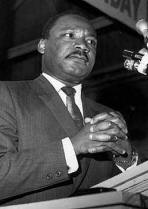
Martin Luther King Day was Monday and I meant to post this then, but I didn't.
This is a tiny bit taken from the end of one of MLK's most famous speeches, usually referred to as the "I've been to the mountaintop speech," which he gave on April 3, 1968. That is, one day before he was shot and killed.
"I have a dream" is a more famous speech, a more significant one. But it's maybe too famous. We all know it so well that it's impact is lessened; worse yet, King's whole memory is wrapped up in it, which is a shame because the MLK I try to think of is the man who has been to the mountaintop. A religious man, a man who fought the power but remained true to his mission of fighting in a non-violent way. A man who was arrested, harrassed, beaten, and still swore never to fight with fists or weapons, but merely his words. A man who, despite that, was murdered anyway.
I've been writing up a thing about the movie "Munich," which I saw last week but seems to haunt me with every new thing I see or think about -- MLK, 24, even James Frey.
These words ... even just reading them can make me choke up. For a brief while during their 2001 tour, U2 played part of this speech during "Pride," and it was utter genius, devastating, sublime.
Martin Luther King, April 3, 1968. Memphis, TN:
"Well, I don't know what will happen now. We've got some difficult days ahead. But it really doesn't matter with me now, because I've been to the mountaintop.
And I don't mind.
Like anybody, I would like to live a long life. Longevity has its place. But I'm not concerned about that now. I just want to do God's will. And He's allowed me to go up to the mountain. And I've looked over. And I've seen the Promised Land. I may not get there with you. But I want you to know tonight, that we, as a people, will get to the promised land!"
Subscribe to:
Posts (Atom)

