Thursday, April 27, 2006

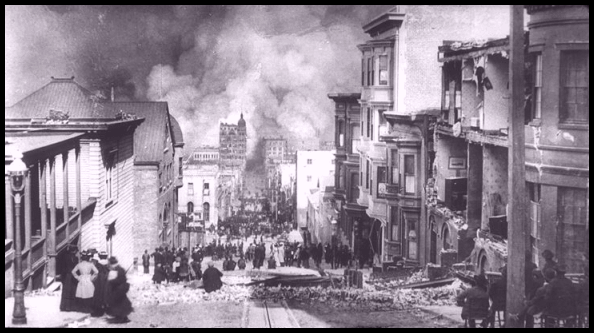
A hundred years ago last week, God tried to take San Francisco. The city was leveled by a shattering earthquake, then burned for three days. But she wouldn’t go.


City Hall after the earthquake and fire

Oh, how I was tempted to write that God tried to take “my city.” San Francisco is the city I love above all others. More than others I have visited and love deeply – Chicago, London, Denver. And surely more than those I have yet to see – New York, Rome. Words cannot express how I love San Francisco, how strong the feeling of desperation can be, wanting to be there. I don’t know if I will ever live there. I know I will always want to.

A hundred years ago last Tuesday (April 18), in the early morning when the sun was just starting to light the day, the earth split open a few miles west of the city, somewhere under the ocean. Modern estimates suggest the magnitude of the quake was 8.25. (Compare that with the earthquake we can probably all remember from 1989 – the one that knocked out whole sections of bridges – that measured a mere 6.7.) Then, of course, the fire came.


Some photos of the city were taken just as the fires were staring to burn.

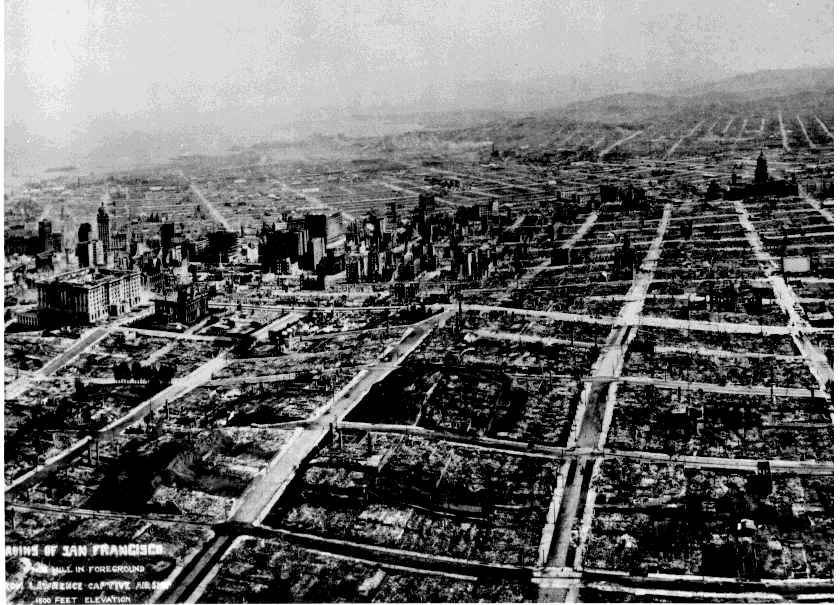
Like so many cities of the time, San Francisco was a hastily constructed city, which is to say it was wooden. The quake both started fires and cracked what few water supply pipe there were that might have helped firefighters. No one ever actually stopped the fires, after three days they had simply burned everything there was to burn. 25,000 buildings were destroyed. As many as 700 died. And 250,000 people were left homeless.


The city, five weeks after the fires burned themselves out.

What is it about great American cities and perilous locations? Rome was famously built among seven hills for protection and as a reward has endured for millennia. Here in America we eschew such logic. Everyone likes to joke about how the Dutch bought Manhattan from the natives for $24 (though the story about it being $24 worth of beads is untrue), but frankly $24 for a swamp isn’t a bad deal. New York, the very capital of the world, is built on a piece of “land” that’s little more than a sandbar between rivers. Chicago burned down in 1871. Then there are Los Angeles and San Francisco, built along beautiful coastlines where mountains meet the sea. Pity that all that beauty is largely the result of one of the world’s more active faults. Consider where I live: Phoenix, the country’s fifth-largest city, built in a place with no water. And must I even mention New Orleans?

Thing is, and I don’t say this to in any way minimize the horror of what has become of New Orleans, some day – probably within our lifetime – something will happen to San Francisco much worse than what happened in the Gulf last September. A 2003 study found a 62% probability that a 6.7 or greater magnitude quake will hit in San Francisco between now and 2032. That is, there’s a better chance than not that within the next 25 years, San Francisco will be hit by an earthquake worse than the 1989 event. Have I mentioned that the neighborhoods hardest hit by the 1989 quake even still aren’t completely repaired?

Simon Winchester recently wrote a book about the 1906 earthquake and devoted the better part of a chapter to warning how easily it could happen again. It’s a terrifying book. Scary enough most Californians don’t even want to hear about it, as he notes in this article.

“Fragile” he calls San Francisco. If you’ve ever been there, can you possibly disagree?


But – and this I know is completely crazy – it doesn’t make me want to live there any less.

I went to New Orleans once and I’m glad I did because I’ll never get to go back. Even if I again make it to a city by that name I know the place will not be the same.

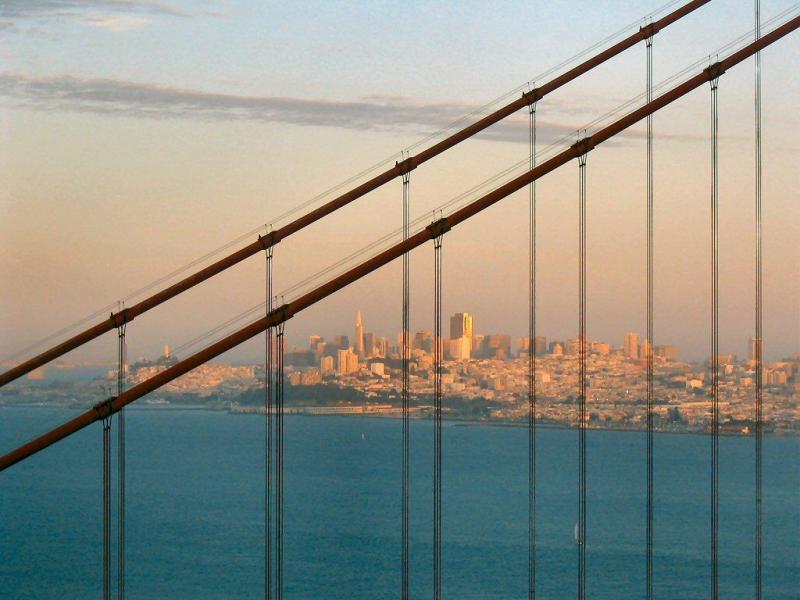
And I still want to live in San Francisco. Because – look at the place – how can you not? Because, if the worst one day happens, at least I would be able to say: I lived there once, before God finally had his way, and took it.


Why wouldn't you want to live in this place?

Stuff

This is why I should have been a judge.

Dan Brown, the author of The Da Vinci Code, was recently sued in British court by authors of 1982 book called Holy Blood, Holy Grail. They claimed violation of copyright based on supposed similarities between the books. They lost. Not just that, the judge all but mocked the claimants in his ruling. But that's not all. Apparently, he also put a code in his decision.

I for one hope that the judge's code points out that if Dan Brown is guilty from stealing from anyone it's from himself - he's now written pretty much the same damn book four times over.

***

Elsewhere in the seemy world of literary scandal, we have proof that just because you go to Harvard doesn't mean you have a brain in your head.

What's more offensive here? How completely blatant the plagiarism was or that she chose to plagiarize a book by Megan McCafferty. I mean, really, if you absolutely have to steal to finish your book, steal something better.

***

Finally, it's no Sopranos, but Big Love on HBO is certainly an intriguing show.

Is the show for or against the practic of polygamy?

It's hard to say. The objectivist argument that the show makes (if only implicitly) is essentially: Assuming you, like a majority of Americans now, support gay or non-traditional marriage on the grounds that consenting adults should be able to enter into arrangements of their choosing and not ultimately be dictated morality by the state, then why can't more than two consenting adults enter into a similar arrangement?

It is a tempting and probably convincing argument that the show seems to be promoting: Bill Hendrickson and his three wives fiercely insist that they are happy and living the life they chose.

The show also (creepily) portrays the most logical and common argument against polygamy: That, in reality, most plural marriages are not the result of choice but are the prodcut of cult-like indoctrination. To that end, the show gives us the Juniper Creek "compiund," which is for all intents and purposes Colorado City, the now relatively famous polygamist society in Arizona near the Utah border. Here one man (a self-proclaimed "prophet") essentially runs everything and has many wives, some of them distressingly young teenagers. The whole thing is both convincing and beyond unsettling.

But where the show is really succeeding is in showing the great extent to which even the Hendrickson's willing, big-city four-way marriage isn't really working. The problem, of course, is jealousy. (An excellent article on the ways jealousy is tearing the group apart is here at Slate.)

It's sad to watch the Juniper Creek scenes, but the scenes at the Hendrickson's are frustrating to watch in their own way. It all seems like it should work out -- one can even imagine how it might be fun to be one of the wives (the fun part of being the husband is, I should think, obvious). Except despite all the potential upside their home life is filled with problem after problem after problem. And realistic issues, too, it's not all completely manufactured TV "problems."

More and more, it seems, the real question the show is asking isn't whether or not we should allow polygamy but why anyone would want to be a polygamist in the first place.

Oh, and also, how often can we show Bill paxton's ass before everyone stops watching altogether?

Friday, April 21, 2006

And you thought Voldemort was evil

The Harry Potter-bashing fun in Georgia continues.

After my last post, Diana commented on an equally (if not moreso) absurd situation in which a certain school administrator disbanded a Harry Potter club when he was aghast to find students "practicing spells" during club time.

Little do those students know how lucky they are that their aspirations to witchcraft were nipped in the bud:

"At Thursday’s hearing, Mallory spoke against the books along with four other parents and students. One of them was Stacy Thomas, a mother of five, who said reading the 'Harry Potter' series made her daughter turn to witchcraft, ultimately causing their Christian family to lose friends, finances and their reputation.

Her daughter, Jordan Fusch, 15, testified that she began experimenting with tarot cards, curses and seances after reading the books.

'As a former witch, I can tell you that witchcraft is not fantasy. ... I felt I could not escape the clutches of witchcraft,' Fusch said. 'It has taken several years of counseling to get to where I was before witchcraft and reading "Harry Potter" books.'"


Fortunately for Jordan she turned away from the dark arts before being led to an even more aboniable fate that is, as Willow Rosenberg would tell us, the inevitable next step after witchcraft.

Thursday, April 20, 2006

Every Country Has Problems With Education

The prime minister of Australia is so upset about schools teaching the postmodern approach to literature that he's considering tying funding to the elimnation of such practices.

I can barely even wrap my head around this. I don't actually have anything against postmodern discussion of literature, but I guess I would generally say it's a bit much for high school. There are so many things about this story that just don't make sense to me as an American. For instance, in most American high schools we're lucky if all the classes can even read Shakespeare. Bonus points if they understand it, and nevermind interpretation postmodern or otherwise.

So, there's some dissonance to realize that in Australia the prime minister can get worked up over how literature is being taught, while here we're more concerned with if it is at all. But the most dissonant thing about this story is to try to imagine the President of the United States even trying to pronounce "postmodern."

Tuesday, April 18, 2006

I haven't actually read the Bible because the type is too small

... maybe I should just let other people tell me what to think. That's the ticket!

Thing is, I actually have read the Bible. I mean, I was doing some serious skimming through all of the "A begat B begat C begat ..." (I mean, I like sex in my literature as much as the next guy but it just got gratuitous.) Anyway, the point is I read the Bible before making up my mind about it: For the record I would say it's often boring, occasionally it's great literature, but I'm not buying the whole 'word of God' thing.

I guess I'm just not as trusting as some people. Which brings me to this lady ...

who wants to ban Harry Potter from the library of the public school her children attend.

The story I linked to is about how most people who heard about her cause decided to defend the Potter books, but I particularly liked these comments the paper noted from their message boards:

"I totally agree with this parent seeking to have Harry Potter books removed. If we suggested the Bible be on a list of mandatory books for students to read as a part of their novel requirement, there would be an immediate protest. Therefore, as a Christian, we must begin to take a stand and begin to show accountability for what our children are being taught and exposed to."

— Posted by Mendi on the message board


Because being in the library is exactly the same as being on a list of mandatory books for students to read.

"I am a Christian. I feel that Christian rights are being abolished in this country. Everyone talks about our views being pushed on them. But what about our beliefs? Don't we have any rights at all?"

— Posted by "red" on the message board


That one is so ridiculous that I'm very tempted to believe it's just sarcastic.

But the best of all is the reason given by the petitioning mother herself:

"On the forms, she wrote that she objected to the series’ 'evil themes, witchcraft, demonic activity, murder, evil blood sacrifice, spells and teaching children all of this.'

She wrote she had not read the series because it is long, and she is a working mother of four."


Where have all the books with good, wholesome blood sacrifice gone anyway? At least she's right about one thing: The books are long. Worse yet, I think once or twice, they may have even made me think.

Frankly I think she's just bitter that an online sorting hat put her in Slytherin.

Monday, April 17, 2006

United 93 follow-up and other stuff

Last week I went to a movie (Inside Man, if you care) for the first time in a while, and while there saw the trailer for United 93. And I have to say, whereas watching it on my home computer gave me a vaguely sick-to-my-stomach feeling and a case of the mopes, seeing it in the theatre elicited a quite different response: Total rage. Hatred. Seething animosity.

Well, you get the point.

My feelings about the film itself remain essentially the same (in a nutshell: I personally have no desire to see a film like that yet, even if it's very good which it may well be considering it's from the guy who made "Bloody Sunday." But much as I don't think it's apprpriate I also don't wish to tell peopl what they can and cannot make movies about. Moreover, Oliver Stone has a 9/11 movie coming out later this summer so don't just blame the makers of this film.)

But there's something about the trailer that makes it unforgivable to me. Something I noticed when I watched the thing online but wasn't as strongly affected by. The brief clip from CNN showing the second plane strike the South Tower.

The thing about that video footage is that no matter how many times I watched and rewatched it on that day and in the years since, it's more than just news footage and I've never been able to forget that. It is, quite literally, a video of a murder. I cannot imagine any other film using actual crime scene footage. Not in the movie and especially not in the trailer.

It's one thing if it's your choice, I think. D and I watched Amityville Horror yesterday and actually lamented that in their "documentary" about the real house that they used so few of the actual crime scene photos, instead relying on "re-created" photos. But that was by choice.

Wednesday night I went to the thatre looking for a simple popcorn bank robbery movie that wouldn't make me think too much. And before I got that I was subjected to a video of an attrocious crime.

I'm not one of those who believes that the families of 9/11 victims should have say over any discussion or representation of that day. Nonetheless, what must it be like to go to a movie expecting to see whatever innocuous movie and suddenly on the screen be watching a video clip of how your husband/father/mother/etc died?

I've said before that I don't want to tell any artist what they can or can't make a movie about. And that's fine. But this trailer isn't the movie. It's advertsing. And it's beyond fucked up to use that video in a an advertisement for the film. The trailer wouldn't be any less effective without the clip. Those who were interested in the movie would still be interested, those turned off by the idea would still be turned off. Either way, the film would have been advertised. In fact, the trailer would still be emotionally powerful. So why use that clip?

I can't come up with a valid reason. But it was the wrong choice.

***

Granted, this is a story about a simple little online poll. But still.

The thing is, on the face of it, I should applaud the result. U2's "One" is among my very favorite songs and the lyrics as a whole are stunning. Take the song as you will (an embittered love song, a confession from a gay son, an essay on AIDS have all been proposed and all seemingly make sense). The song challenges and gets racy and ... well, basically I just think it's a really good song.

The problem is, the lyrics from "One" that won this competetion were the worst part of the song: "One life with each other, sisters, brothers." I'm sorry but yawn. Why didn't everyone just vote for "We Are the World"?

Then I realized Robbie Williams also made the list and felt slightly better. Clearly, the contest was only open to pre-teen girls.

***

Crazy.

***

And I realize this is the height of ... being a hypocrite (hypocritciscm? hypocritcalness?) but I really appreciated this blog entry. I know I'm often snarky (again, see above), but it's good to remember you really need to be a fan first.

Wednesday, April 05, 2006

2 links; 2 divergent moods

I'm not totally sure I even understand what's going on in this story, but even though we can all agree he's probably right, it's pretty great to see a pastor actually quoted as saying:

"Jesus is not OK with it."

I had to read the article a couple times to realize the "it" Jesus isn't OK with is pornography, not the publisher's decision.

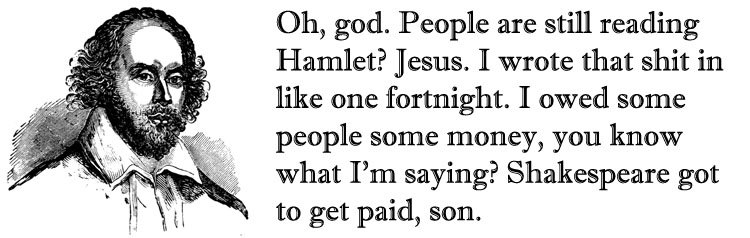
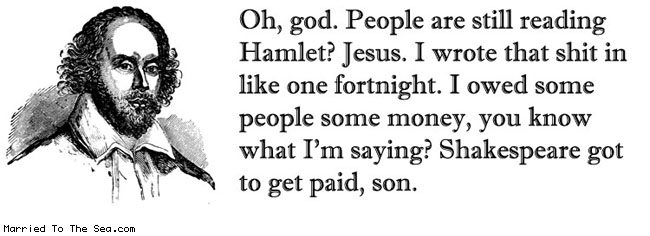
Still, Jesus is not OK with it. And Shakespeare still got to get paid, son.

***

I feel like I should have a strong opinion about this movie ... the thing is I really don't.

I probably would if I saw it, but I've really no desire at all to see it. Just watching the preview made me unbearably sad and I'd rather not have two hours of that feeling. My lack of desire to see the movie is an opinion, I suppose, but it's not a strong one.

My feeling is that I would hate the movie, just despise it. Because, for me at least, it's too soon. It wasn't even five years ago that I (like the rest of you) actually lived through that day and even watching the trailer and remembering it as I write this now causes a sadness that is literally physical (tears, trembling, shortness of breath).

But who am I to tell people what art they can and cannot make? I refuse to do that, but I don't necessarily need to patronize the movie.

Some day, not yet for me and maybe not even within my lifetime, the time will be right for a movie like this. It was more than 50 years between D-Day and when Saving Private Ryan opened and I remember many people who had lived then were even still uncomfortable with it. But for people in my (even my parents') generation who knew the stories but hadn't lived through it, the movie was a powerful lesson - it made a heroic but flat incident on the page of a history book truly come alive. Someday my children may similarly find the events of that terrible day more of a curiosity than a horror. Maybe then a movie like this could help them to understand why those two numbers 9-11 are still so powerful in our culture. God willing it will remain an isolated and shocking event, not merely the first of many disastrous days.

But, frankly, I can see no real reason to make this movie now besides money. Of course, it's the motivating factor behind everything in Hollywood. Even the few people who are in it for the art only do so at the behest of those holding the pursestrings. But my God, who really thinks 9-11 is an appropriate thing to wring for profit?

For what it is, the movie doesn't look all that bad, judging by the previes. At least it doesnt seem to Wesley Snipes-ish.

It's not that I'm not interested in stories that are in some way "about" 9/11. I've read several books in the past years that use that day in one way or another to tell a larger story ("Extremely Loud and Incredibly Close" comes to mind, as do "Saturday" and "Pattern Recognition". I also hear the new McInerny book is "about" 9/11 in a way, too.). But we're talking about larger stories, not just retellings of that day's events. (In fact I have read one book just about that day's events and so far as I'm concerned it's the only one worth reading: The 9/11 Comission Report.)

I say all of this with hesitation, though - my opinion is not strong. These are vague notions if anything at all.

Even if United 93 is good, moving but not sappy, dramatic but not heavy-handed, sensitive without being treacly ... even if it's everything it can be, how much can it really be? What is this movie aiming to contribute? We all know the story already.

Wednesday, March 29, 2006

I was all ready to buy myself the wonderful "Prose before hos" shirt but then I found this one, which is seriously competing for my affections.

Though, the full story of why is only revealed here, and is not on the shirt, sadly.


I had dreams of wearing one of these shirts to the Shakespeare class I have to take in fall semester, but it won't happen ... the class is online. But I'll totally wear them once I'm actually the teacher.

Tuesday, March 28, 2006

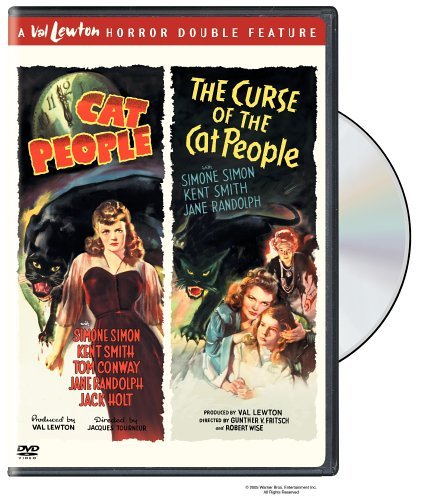
With apologies to my wife and many of my best friends, I don't really like horror movies. But in college I saw one horror movie that I absolutely loved. It was Val Lewton's 1940's movie "Cat People" (do not even talk to me about that godawful 80's remake).

My love for it tends to highlight why I don't like most modern horror movies. For years, I looked for the film but couldn't even find it on VHS. Happily, it was released (with a lot of Lewton's other work) on DVD just last year. And I just found this wonderful article from Roger Ebert's great movies series about the movie, as well.

I don't even remember why for sure I watched the movie. I saw it as part of a "Film and Literature" class. Generally, we read a book, watched a movie based on the book, and discussed. There were some older movies and a few never ones - Kiss of a Spider Woman and Clueless come to mind. But Cat People isn't based on any book so far as I can tell and I don't recall reading anything with even vaguely ssimilar things. Maybe the prof just really liked the movie and wanted to show it, for all I know. If so, good on ya, prof.

It's a mood piece. Not for everyone. But I really encourage you to give it a chance (it's short!). Watch it with the lights off and no distractions. It's way scarier than "Scream."


***

Other stuff I like right now:

1. James Blunt
2. Ben Harper, esp. his new CD "Both Sides of the Gun"
3. The new season of The Sopranos
4. For that matter, season 1 of The Sopranos, which I have been re-watching with Diana
5. Big Love (new show on HBO)
6. really just HBO in general
7. Chino Bandido
8. that wet stuff what has been falling from the sky lately

Saturday, March 25, 2006

The living

Disclaimer

The world has seen a lot of writing about death. It is, after all, the most universal theme imaginable. Writers (who generally ply their trade as a kind of therapy) are especially likely to write about death. And, once something is written, the writer’s temptation to share it (even if it was only written for personal reflection) can be too strong to resist. So we have entire sections of bookstores on death and grieving. And (seeing as I don’t have a publisher willing to indulge my every written whim) we now have this blog entry.

Subject

Two of the books I’m reading now are about death. This was not necessarily intentional, but neither is it wholly a coincidence – death has been on my mind more than usual lately.

Maybe it’s because my grandmother has been sick. Last year she had a stroke and now she has breast cancer. This is my maternal grandmother who has always been (as grandmothers go) youthful, independent, and intelligent and eloquent beyond all reason. For years, even decades, I have been preparing myself for the death of my paternal grandparents. They are older and have been in generally poor health for a very long time. They live in Nebraska and have scads of other grandchildren and frankly have never been a part of my life in the major way my grandma Lucore has been. And, sad to say, I always expected my Dad’s parents would go first. I haven’t seen them for almost four years but I still have the mental picture of the last time I saw them – a habit I got into many years ago when visiting them, because I was aware the opportunities might be few. But now my Mom’s mom is showing startling and terrible signs of her mortality and it hurts like being hit in the stomach.

Also, a few weeks ago, apropos of nothing so far as I know, Diana asked me about death and dying and the extent to which I have known people who died and what it’s like. Maybe it was because of that I have been keenly aware this month that it’s now been five years since my friend Gwen died. Five years ago this month. And I’m sure it would have been on my mind anyway, but Diana’s question put me in a particularly philosophical mood about it all.

Anyway, this obscenely long post is not really a book review, though it kind of is – it’s mostly some thoughts about a not-especially-blog-friendly subject: death. Or, more specifically, living after those we love have died.

Background

I have known a few people who have died. Many older relatives of some degree of removal. I’ve been to lots of funerals that were really nothing more than formalities. But I have been to two significant funerals in my life, and missed one other that would have been the most significant of all.

I remember my great grandfather, but I can recall nothing of his death. He and my great grandmother lived in New Mexico and I suppose the greatest impact his death had on me was that it meant my great grandmother moved to Pueblo to be near my grandmother and so I saw her much more. She died when I was five or six. It was a Saturday morning and I was watching cartoons. My parents were still asleep. The phone rang but one of my parents (probably my Dad) answered it before I got to the kitchen. I went back into the living room, watching TV. Then my parents called me into their bedroom and told me great grandma had died. I don’t know that I really understood but I was very aware of how sad my mother looked about it and so I was sad, too. I went back into the living room and a McDonald’s ad was playing. This was when I began to hate clowns and their fake, painted-on smiles, and especially Ronald McDonald. I dressed up and we went to Pueblo for the funeral, during which I fell asleep. On the way back home I started to understand what it means to be dead – we never went to Pueblo without seeing my great grandma, but we had just been and I hadn’t gotten to see her and from what everyone was telling me I never would get to again.

When I was a freshman in college, I was in a long-distance relationship with a girl who still lived in Denver. Her sister had died very suddenly from leukemia a few years earlier and the loss had absolutely wrecked her family. One morning in December, a few hours before I was supposed to take a math final, my girlfriend called and woke me up. She was crying. It had happened before and from the very first moment I tried to soothe her and tell her it would be OK. But she told me that I was wrong, it was not OK. She told me her mother had killed herself in the night. I think I may have flunked the final. Just a few days later I was back in Denver for winter break. It was one of the coldest weekends I can remember in Denver. The first time my parents met any member of my girlfriend’s family was in the receiving line after the funeral. A Christian service for a woman who has committed suicide is awkward enough but toward the end a piece of music was played. Toccatta, maybe? Several rows in front of where I sat with my parents and for no immediately discernible reason, my girlfriend stood during the playing of the song. Everyone else remained seated. When, later, I asked her why, even she seemed not to know. “It seemed like the thing to do,” she said. I think it was defiant, a final fuck-you to her mother, who took the pills just after an argument with my girlfriend. Death, I learned, does not always bring on grief.

And then there’s Gwen, who was my best friend sometimes and sometimes almost like a girlfriend and sometimes someone who broke my heart and who I hated. And I don’t talk about her much because it’s awkward and because I think if I were Diana I might not want to hear about it all the time. But Gwen, who died five years ago this month in a car accident that was her own stupid fault, is ultimately the only real experience I have with loss and grieving. She lived in New York when she died and I was in Tucson and didn’t even find out for days that she was gone. I didn’t go back to New York for the service and I don’t know what her mother did with the ashes. The closest I got to saying goodbye was a small gathering I had with four other people who had known her in Tucson. We lit some candles and we talked about her and we cried a lot and that night it seemed like maybe it was some kind of closure but the next morning I woke up and nothing was different.

Losing Gwen, for me, was fundamentally different than most significant deaths because she was not physically close to me at the time and hadn’t been for a couple of years. We were still very close as friends, but I was accustomed to not seeing her, I was used to the feeling of thinking of her and wishing she was around. It’s the way I feel today about Tony in Chicago. Except that if I see something that makes me want to talk to Tony I can call him and I used to call Gwen for the same random reasons – and now I can’t. Gwen’s death is not a constant hole in my life because for two years before she died she wasn’t constantly there. I had already, with the benefit of a few thousand miles, conquered what I imagine to be the most difficult part of the death of a loved one – the lack of their physical presence. Which is not to say that her death was not devastating to me, for it was. But what I do mean is that I have been surprised while reading Joan Didion’s startling memoir about the death of her husband to find how similar my grief was, how similar it is.

The Books

Joan Didion’s husband died, very suddenly, at the end of 2003. That event and the experiences of the year that followed, form the basis for her newest book, a memoir called “The Year of Magical Thinking.”

The other book is fiction, an almost sci-fi novel by Kevin Brockmeier, called “The Brief History of the Dead.” The book takes very literally an idea common to many African and some eastern cultures that there are not two states of being (alive and dead), as we generally believe in the West, but three: living, the recently deceased who are still “alive” in the memories of the living, and the forgotten dead. “Brief History” takes place partly in a city inhabited by that middle category, those who exist only in the imaginations of those still living. They come to the city when they die, and survive there only until all the people who remembered them are still living – then they vanish. The book takes this concept much farther with a global plague and other adventures, but it’s the philosophy that everyone (me included) wants to talk about, not the plot.

Just thinking with my fingers

I like the idea of that middle state of existence. It fits with my ultimate belief that there is no afterlife and that we are nothing more than what we leave behind. And it seems kind of true, as well: Gwen isn’t really gone for me. I still think of her. I know others who do. Two years ago I bizarrely ran into Gwen’s freshman year roommate at Coit Tower in San Francisco and we spent just a few hours together and we didn’t talk about much except Gwen. So long as she lives in my memory, then, she’s not really, completely gone. Is she? I don’t now remember much about my great grandmother but I do always think of the way she would touch the top of my head. That might not affect me as much as memories of Gwen (or my ex-girlfriend’s mother) do, but they’re still real memories, strong, clear.

My problem comes from one of the only other books I have read about dying and grief, which I read after Gwen died because when someone you know dies you will inevitably be given a copy of this book (maybe by me), called “A Grief Observed” by CS Lewis about the death of his first wife. He wrote:

“Slowly, quietly, like snow-flakes – like the small flakes that come when it is going to snow all night – little flakes of me, my impressions, my selections, are settling down on the image of her. The real shape will be quite hidden in the end.”

This is true of all memory – we remember what we want to remember – but is especially true and worth remembering when thinking about the dead. After all, I don’t fully know anyone, even my wife – I have but impressions and selections of her. I have only what she chooses to show me and the way I interpret that. The thing is that while she’s living my idea of her continually grows, every interaction with a person you know challenges your idea of them, offers a chance for you to re-write the file that the computer of your brain has labeled with their name. But if that person should die, they no longer have the chance to challenge you and your own vision can become the reality – you can choose the details that best fit your needs and forget the rest. Most of us forget the bad times – the dead are more often than not angels in our memory, no matter how much they may have hurt us when living. Then again, at least in the short term aftermath of her mother’s death, my ex-girlfriend remembered none of the good things about her mother – only remembering the fights made it possible to hate her.

And I tend to feel that if I die the part of me that lives on in the memories of those I have known will not truly be me. Pieces of me, maybe. Fragments. But not me. I haven’t read far enough into “Brief History” to yet know if this identity problem is an issue in the world of the dead, but it seems a bit much for such a slim book to take on.

What I’ve marveled at from the initial chapters of Didion’s memoir is the way our brain never fully comprehends the notion of death. It is very literally unimaginable. We have many theories of what being dead is, but we cannot know. So, when someone close to us dies, it never fully makes sense.

I have always assumed, to the limited extent that I think about death, that it’s the physical part that drives home the reality. Maybe this is because the way I miss Gwen – as I described before – is not physical, but emotional. I had already adjusted to the physical distance before she actually died. My assumption, then, has generally been that if someone who is literally physically close to you dies that the reality of it is much more immediate. Clearly, it will make the loss of that person worse in the short term. But my guess was that, in the long run, the physical withdrawal would also result in a better mental conception of the reality of the person’s absence. Didion’s memoir tells me that this is not so. Even in the midst of her struggle – and it is of course a horrible struggle – to adjust to the physical loss of her husband, what she finds harder is to accept, to mentally conceive, of his death. I sometimes catch myself thinking I should call Gwen, or that it’s been a while since she called me – Didion, similarly, keeps expecting her husband to walk through the front door. She won’t get rid of his clothes or his shoes – she assumes he will need them as soon as he is back.

It’s a beautiful book, marvelous in its awful, dark honesty. Highly recommended.